
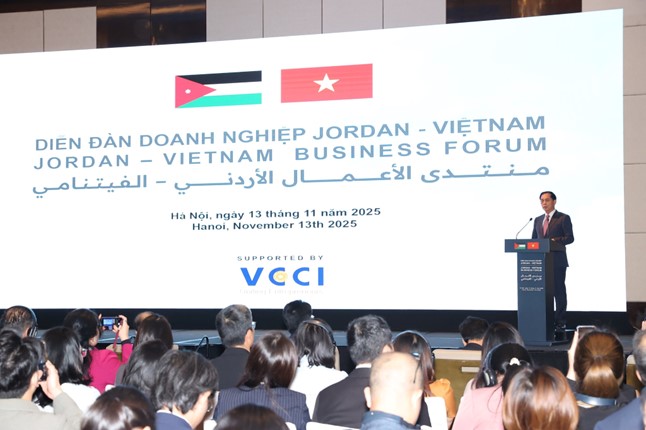
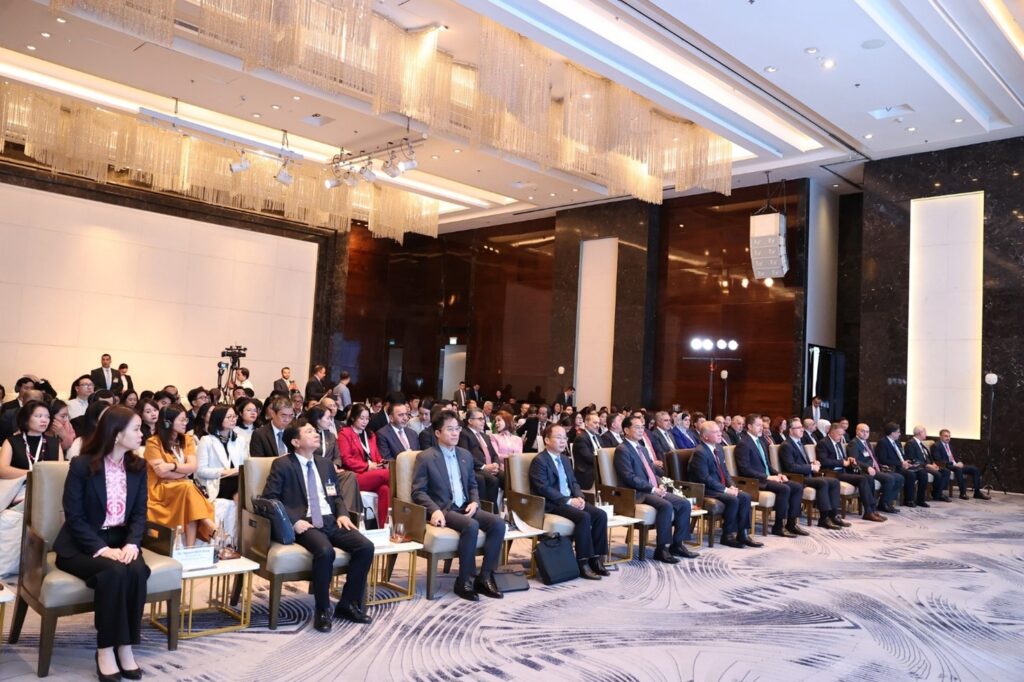
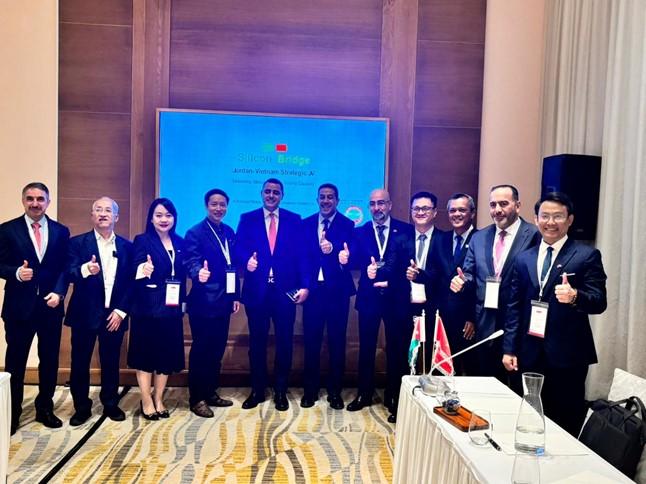
On November 13, 2025, within the framework of the Vietnam–Jordan Business Forum held in Hanoi, VSAP Lab — Vietnam’s first Lab-Fab for advanced semiconductor packaging — participated and shared insights at the Semiconductor Roundtable alongside leaders of the Amman Chamber of Industry and business communities from both countries. This event marked an important step toward promoting investment cooperation, technology transfer, and the expansion of the semiconductor value chain between Vietnam and Jordan.
At the roundtable, VSAP Lab presented its practical approach to building a semiconductor ecosystem structured around three key pillars: infrastructure & technology, human capital & training, and international collaboration. As a pioneer in ATP (Assembly, Test & Packaging) technology in Vietnam, VSAP Lab focuses on an integrated model that connects R&D and pilot manufacturing, while actively linking with universities, industry partners, and research centers across the region.
According to VSAP Lab, the foundation of an emerging semiconductor ecosystem does not lie primarily in capital investment or factory scale, but rather in identifying the right technological segment and establishing sustainable linkages among ecosystem participants. For new entrants to the semiconductor industry — including Jordan — prioritizing value-chain segments such as packaging, testing, and system design, rather than competing in leading-edge manufacturing nodes, can deliver faster impact and more sustainable growth.
VSAP Lab also emphasized the crucial role of attracting global experts and building international cooperation networks in the early stages. Collaborative projects with research institutes, universities, and companies across Asia, the Middle East, and Europe help accelerate technology development, support workforce training, and expand market opportunities for Vietnam-developed semiconductor products.
One of the most discussed topics at the forum was the development of high-quality semiconductor talent. Jordan is actively expanding technical training programs in microelectronics, information technology, automation, AI, and materials science. However, a major challenge — one shared by many emerging semiconductor nations — is aligning training programs with actual industry needs.
Drawing from its own experience, VSAP Lab shared that it is implementing an ATP+ Talent Development model that combines hands-on laboratory training, industry technical internships, and an international mentoring network involving experts from global semiconductor companies. This model can be adapted for developing nations to cultivate engineers with practical skills, ready to contribute directly to production environments.
VSAP Lab also affirmed its readiness to collaborate with Jordanian universities and training organizations to develop specialized training programs for packaging & testing engineers, semiconductor system design engineers, and advanced materials specialists.
During the meeting, Jordanian representatives expressed strong interest in collaboration models aligned with the country’s capabilities and infrastructure, including:
- Joint development of a semiconductor training laboratory based on the shared Lab-Fab model.
- Cooperation in advanced packaging technologies and participation in the future chiplet supply chain.
By participating in the Vietnam–Jordan Business Forum and contributing to the semiconductor roundtable, VSAP Lab continues to reaffirm its role not only as a high-tech project in Da Nang, but also as a bridge for international cooperation, promoting innovation in Vietnam and expanding the regional influence of the country’s emerging semiconductor ecosystem.
Phuc Le


 Tiếng Việt