
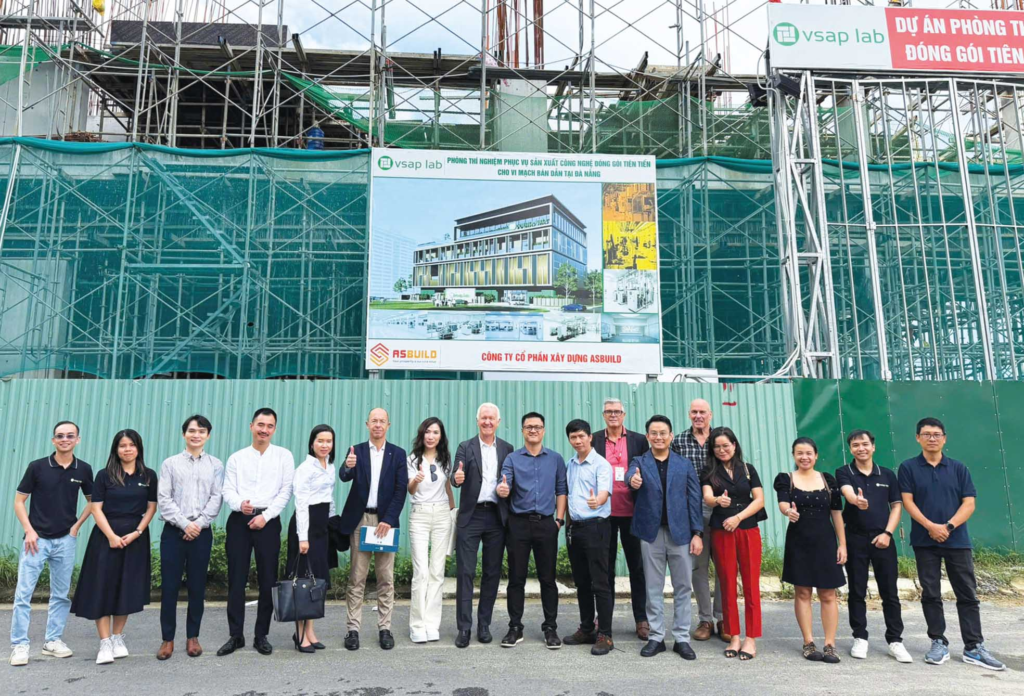
In the context of Vietnam seeking a substantive path in the global semiconductor industry, VSAP LAB has emerged as a bold experiment with advanced packaging technology—a piece of the puzzle that many experts consider the most feasible for participating in the microchip value chain.
“Receiving the mandate” as a pioneer
“Not only a technical work, but VSAP LAB is also a manifesto for the spirit of innovation, for the determination to master core technology, and for the fierce belief that Vietnamese people can conquer the most sophisticated and complex technologies of the semiconductor industry—a key industry of the future.”
That affirmation was not just to introduce the Project of a Laboratory serving the production of advanced packaging technology for semiconductor microchips in Da Nang (Fab-Lab), but also the way Nguyen Bao Anh, co-founder and CEO of VSAP LAB Joint Stock Company, “received the mandate” for the path he chose.
Nguyen Bao Anh is one of the members of a group of Vietnamese experts who gave up stable positions and ideal working conditions at major semiconductor technology corporations to return and contribute to the country. Their motivation comes from the belief that Vietnam is standing before a rare opportunity and if it is slow, the country may miss a major technological revolution of the era.
Having worked at Synopsys—the world’s leading corporation in chip design—Nguyen Bao Anh reached high career milestones that many engineers dream of. But the deeper he went into the industry, the more he realized an invisible limit.
“Even though I reached the position of senior director, and the Vietnamese engineering team directly developed new technologies, we were still only allowed to do what others permitted. Core, truly important technologies are very difficult for the team in Vietnam to be entrusted to master. That is the limit of being a hired laborer,” he said frankly.
In the context of a rapidly changing world and increasingly fierce technological competition, the problem of technological autonomy becomes more urgent than ever. A factory of a large corporation can be built in Vietnam, but it can also be withdrawn at any time. At that time, the future of hired Vietnamese engineers remains a big question mark.
It was these concerns that urged Nguyen Bao Anh to nurture a long-term roadmap: how for Vietnam to gradually master semiconductor technology, instead of just standing in the position of processing and dependence.
After many years of market and technology research, he came to an important observation: instead of rushing into chip production—a field that requires billions of dollars in capital and direct competition with countries and regions like the US, Taiwan, and China—the most feasible direction for Vietnam currently is advanced packaging technology.
According to him, an advanced packaging factory only needs an investment level dozens of times lower than a chip factory, while this is a relatively new field in the world. The technological gap between Vietnam and leading countries is therefore not too far.
“Making a chip to compete directly with the US, Europe, or Taiwan makes it difficult to win on quality. If the quality is lowered, it cannot compete with China on price. Therefore, opening a chip production company at this time has a very low probability of success,” Bao Anh stated.
More importantly, advanced packaging technology encompasses many stages in the chip production chain, creating conditions for Vietnam to build and train a workforce step-by-step, instead of immediately requiring a force of seasoned engineers—something Vietnam cannot currently meet.
“If a chip factory is built suddenly, where will the human resources come from to operate it? In countries with chip factories, it takes dozens of years to build a team. Advanced packaging gives us a gradual roadmap: learning while doing, training, and deeply understanding the entire chip production process,” he emphasized.
Thanks to a special connection, Nguyen Bao Anh had the opportunity to connect with a team of world-leading overseas Vietnamese experts, including Ms. Bich Yen Nguyen—a famous expert with hundreds of patents in the semiconductor technology field.
“All of us share the same belief that advanced packaging is the right path. We met in the final months of 2024 and began discussing extensively to find the most suitable direction for Vietnam,” Bao Anh recalled. VSAP LAB Joint Stock Company was born in that context.
According to the plan, the company was established in March 2025, and completed fundraising in April 2025. By July 2025, the project began laying the first bricks. It is expected that in the second quarter of 2026, part of the production line will be put into operation—a progress that many international experts evaluate as “lightning-fast” compared to the general standard of the semiconductor industry.
To the pathbreaker
Behind that impressive progress, in the eyes of the engineer, there is still no small amount of worry. Because according to him, “difficulties are everywhere,” and the most difficult thing is still the severe lack of an ecosystem.
“Everything we are doing is almost unprecedented and not readily available in Vietnam. VSAP LAB must play the role of the pathbreaker, colliding with completely new issues,” Bao Anh worried.
Difficulties started right from the stage of designing and constructing cleanrooms with technical requirements at the highest level, reaching international standards such as Class 10000, Class 1000, and Class 100. These standards forced the team to self-research, learn from foreign experience, and learn directly from experts. Even cleanroom construction units had to be proactively searched for by the enterprise domestically and abroad to be assembled into a specific construction ecosystem.
Not only the factory, but the problem of machinery and equipment is also a big challenge. In 2025, the global demand for advanced packaging exploded, making specialized machines scarce. The enterprise had to work closely with suppliers to place orders suitable for its own technical requirements.
“Machinery for the microchip industry is not available for purchase. Manufacturers only design and manufacture according to specific configurations when an enterprise places an order. Furthermore, no country completely masters the current semiconductor machinery ecosystem; each country is only strong in certain stages,” Bao Anh explained.
Difficulties continued to double when production time was prolonged, and the transportation and installation stages were complex, while Vietnam had never imported many types of similar equipment. This forced the enterprise to work closely with customs authorities and service units to resolve arising procedures.
Fortunately, VSAP LAB’s story has created resonance and great inspiration. Many reputable equipment suppliers in the world expressed their desire to accompany and support the enterprise in both technology and delivery progress.
Another obstacle comes from the project having many specifics in production, construction, and an unprecedented business model directly related to policy. Therefore, VSAP LAB must coordinate closely with the government of Da Nang city for guidance, to resolve obstacles, and to build plans to put the project within the framework of current legal standards.
However, Nguyen Bao Anh also said that many policies supporting the microchip industry of the Central and local governments have currently only stopped at documents. VSAP LAB, in its role as a pioneer, will be the place to test and put those policies into practice.
In particular, the issue of intellectual property rights protection is a major obstacle for high-tech enterprises. “VSAP LAB will certainly have many patents because we take research as the center. This is also the path through which the enterprise wants to provide feedback and suggestions so that intellectual property policies are more suitable for reality,” he expressed.
In a picture of an ecosystem with many missing pieces, the CEO of VSAP LAB shared that the mission of the enterprise is to contribute to accelerating the formation of the semiconductor microchip ecosystem in Vietnam. “When we dare to go first, other businesses will be less hesitant. If everyone waits and looks at each other, there will be no pathbreaker,” he said.
When the factory goes into operation, the business model proves its effectiveness and participates well in the market, VSAP LAB expects to become an “anchor,” attracting partners supplying machinery, services, and materials as well as international customers to Vietnam to set up offices and build production facilities. From there, a semiconductor ecosystem will gradually be shaped.
Commenting on the future of the chip manufacturing and advanced packaging industry, the leader of VSAP LAB said that if Vietnam can build and master key technologies, participating deeply in regional and global supply chains, then the microchip market in general and advanced packaging in particular will open up many opportunities.
What needs to be done right now is to step-by-step build and consolidate the related ecosystem. Difficulties will certainly remain, and Vietnam will need more “pathbreakers” in different fields of the microchip industry, not just advanced packaging.
“Our opportunity does not last long. If we do not take advantage of it to master this technology, the opportunity will pass. Therefore, we must save maximum time to focus on research, development, and step-by-step mastering the technology,” Nguyen Bao Anh confided.
Source: www.baodautu.vn

 Tiếng Việt