
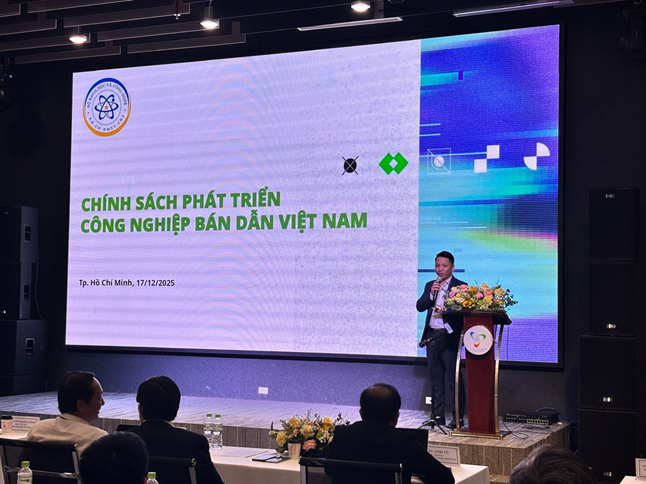
On December 17, 2025, in Ho Chi Minh City, the Ministry of Science and Technology (MOST) organized the workshop “Developing Policies and Solutions to Promote Vietnam’s Semiconductor Industry”, with the participation of representatives from ministries, government agencies, research institutes, and domestic and international technology enterprises.
At the invitation of the Department of Information Technology Industry (Ministry of Science and Technology), the representative of VSAP Lab attended the workshop, directly updating on national strategic orientations, newly issued policy mechanisms, and key solutions aimed at accelerating the development of Vietnam’s semiconductor industry in the coming period. Many of the discussions at the workshop were assessed as being closely aligned with the mission, vision, objectives, and development roadmap of enterprises such as VSAP Lab, particularly in the areas of semiconductor packaging, testing, and ecosystem development.
New Policies – A key driver for the Semiconductor Ecosystem
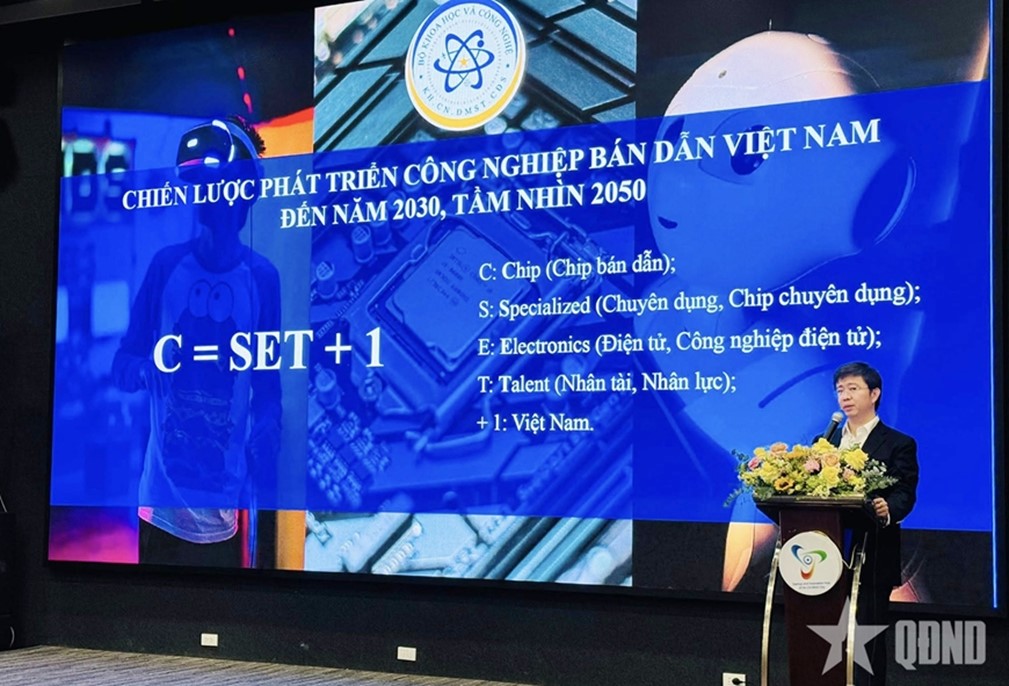
According to the Vietnam Semiconductor Industry Development Strategy to 2030, with a Vision to 2050, Vietnam has identified high-quality human resource development as the top priority, aiming to become a global semiconductor talent hub capable of deeply participating in multiple stages of the semiconductor value chain.
At the same time, the Strategy emphasizes the concentration of resources and the application of special incentive mechanisms for research, design, and manufacturing of specialized semiconductor products. These efforts are expected to create a strong foundation for the development of related sectors such as electronics, digital transformation, artificial intelligence (AI), the Internet of Things (IoT), and AI-enabled electronic devices. Speaking at the workshop, Mr. Bui Hoang Phuong, Deputy Minister of Science and Technology, noted that Vietnamese enterprises and engineers have gradually participated in various stages of the semiconductor value chain. In particular, chip design is considered an area where Vietnam has a clear advantage, while packaging and testing are identified as segments with significant potential for Vietnam to develop into a regional and global semiconductor packaging hub.
Building a Legal Framework and Infrastructure for Long-Term Development
To address existing bottlenecks, the Ministry of Science and Technology is progressively improving the legal framework, while implementing priority mechanisms for budget allocation, research infrastructure, and foreign investment attraction associated with technology transfer and the establishment of R&D centers in Vietnam.
One key solution highlighted at the workshop is the establishment of a National Semiconductor Prototype Manufacturing Support Center based on the Multi Project Wafer (MPW) model. This model is expected to reduce costs, shorten prototype manufacturing cycles, and provide practical output support for the chip design activities of engineers, research institutes, and domestic startups.
In the long term, under the 2050 vision, Vietnam aims to gradually prepare the necessary conditions to attract investment in, or develop, semiconductor fabrication facilities, thereby mastering core technologies and enhancing the country’s position in the global semiconductor value chain.
Exceptional Incentives – Major opportunities for Semiconductor Enterprises
The workshop also clarified important new points of the Law on Science, Technology and Innovation and the Law on Digital Technology Industry (issued in June 2025), which together establish a solid legal foundation for the development of Vietnam’s semiconductor industry.
Accordingly, semiconductor R&D and manufacturing projects with investment capital starting from VND 6,000 billion are now eligible for special incentive policies, including:
- Preferential corporate income tax rates for special investment projects;
- Full exemption from land and water surface rental fees;
- Personal income tax exemption for high-quality human resources for up to five years;
- Five-year work permit and visa exemptions for foreign experts.
These mechanisms are regarded as powerful levers to attract high-tech enterprises, startups, and innovation-driven companies to participate more deeply in Vietnam’s semiconductor ecosystem.
Enterprises and Human resources – Key success factors
Workshop participants shared a common view that the private sector plays a pivotal role in turning Vietnam’s semiconductor development strategy into reality. High-tech enterprises and innovative startups not only contribute to building domestic capabilities but also serve as critical bridges connecting local players with foreign-invested enterprises (FDI).
At the same time, human resources continue to be identified as the decisive factor and the greatest challenge. Strengthening collaboration among the Government, educational institutions, and enterprises—along with demand-driven training models and the attraction of international experts—is considered the key solution to addressing this challenge.
VSAP Lab ready for a new development phase
From VSAP Lab’s perspective, the orientations and policies shared at the workshop demonstrate an increasingly strong alignment between national strategies and the practical development needs of the semiconductor ecosystem. This alignment provides an important foundation for VSAP Lab to continue refining its Lab-Fab model, focusing on advanced packaging, testing, prototyping, human resource development, and deeper integration with both domestic and international ecosystems. With clear policy directions and strong incentive mechanisms in place, VSAP Lab looks forward to 2026 as a year of active engagement and practical implementation of these policies, contributing meaningfully to the development of a sustainable, competitive Vietnamese semiconductor industry that is deeply integrated into the global value chain.
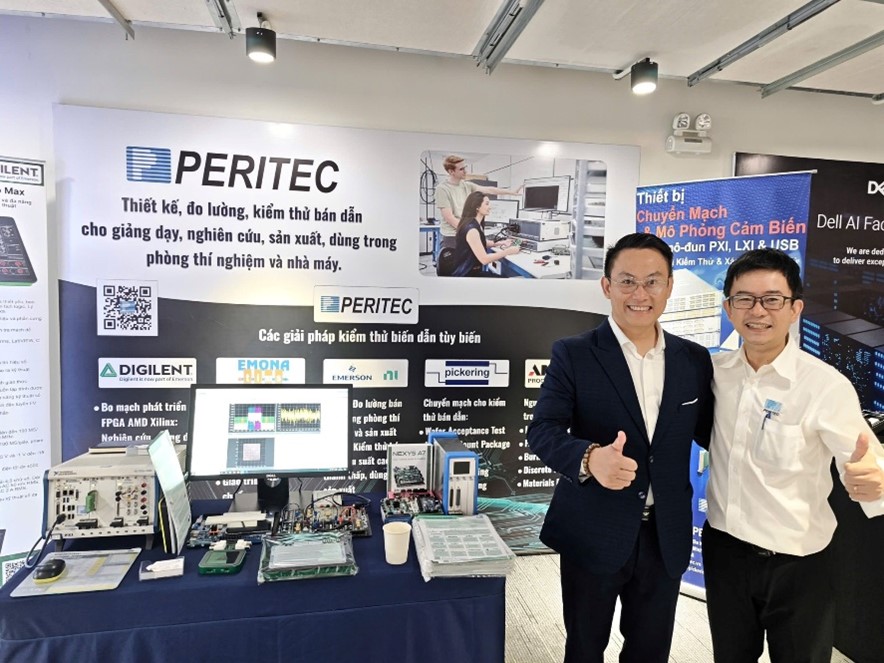
Image: Mr. Le Hoang Phuc – Director of Public Relation and Business Development at VSAP Lab – engaging in collaboration discussions with semiconductor companies participating in the event
(Phuc Le)

 Tiếng Việt