
Vietnam is accelerating its ambition to become a key player in the global semiconductor supply chain, with advanced packaging emerging as a strategic entry point for the country’s technology ecosystem.
This direction was reaffirmed at the first 2026 meeting of Vietnam’s National Steering Committee for Semiconductor Industry Development, held on March 10 and chaired by Deputy Prime Minister Nguyen Chi Dung. The meeting brought together leaders from ministries, local governments, universities, and leading technology companies including Intel, Amkor, Marvell, Renesas, Viettel, FPT, Phenikaa, CoAsia, and VSAP Lab.
At the meeting, the government emphasized that Vietnam is on the right trajectory and has begun to establish the foundational pillars for building a domestic semiconductor industry. The steering committee adopted a guiding principle for 2026: “Decisive implementation – coordinated action – focused priorities – tangible results.”

Vietnam strengthening its role in the global semiconductor supply chain
Driven by the rapid expansion of artificial intelligence, cloud computing, and connected devices, semiconductor demand continues to grow globally. Recognizing this opportunity, Vietnam has identified the semiconductor sector as one of its 11 strategic industries for national development.
According to reports presented at the meeting, Vietnam has already begun integrating into multiple stages of the semiconductor value chain, particularly in assembly, packaging, and testing (OSAT)—a segment where Southeast Asia has become increasingly important to global chipmakers.
To date, the country has attracted 241 semiconductor-related foreign investment projects with a combined value exceeding USD 14.2 billion. At the same time, Vietnam’s chip design ecosystem is expanding, with over 50 design companies employing approximately 7,000 engineers. There are 10 semiconductor assembly and test (OSAT) companies, among which the VSAP Lab project is expected to become the first advanced semiconductor packaging initiative developed and operated by Vietnam (by July 2026). The facility will function both as an R&D center and a pilot-scale manufacturing site, with a projected capacity of around 10 million units per year.
Vietnam is also implementing its National Semiconductor Strategy to 2030 with a vision to 2050, under Decision 1018 issued by the Prime Minister. Of the 38 strategic initiatives outlined in the plan, many are already underway and progressing on schedule.
Another milestone highlighted during the meeting was the groundbreaking of Vietnam’s first high-tech semiconductor fabrication facility in January 2026, signaling the country’s determination to deepen its technological capabilities and move further up the semiconductor value chain.
Building a more complete semiconductor ecosystem
Despite these promising developments, government leaders acknowledged that Vietnam still faces significant challenges in building a fully integrated semiconductor ecosystem.
Key constraints include the shortage of high-level talent, limited R&D infrastructure, and the need to strengthen domestic technological capabilities while expanding international cooperation.
To address these challenges, policymakers emphasized the importance of a “Government – University – Industry” collaboration model, which aims to accelerate research, technology development, and workforce training while strengthening innovation capacity.
Various ministries have been tasked with advancing this agenda through policy incentives, infrastructure investment, international partnerships, and expanded education programs focused on semiconductor engineering.
VSAP Lab positioning Vietnam in advanced packaging innovation
Within this evolving ecosystem, VSAP Lab (Vietnam Semiconductor Advanced Packaging Lab) is emerging as a key domestic initiative aimed at strengthening Vietnam’s technological capabilities in semiconductor packaging.
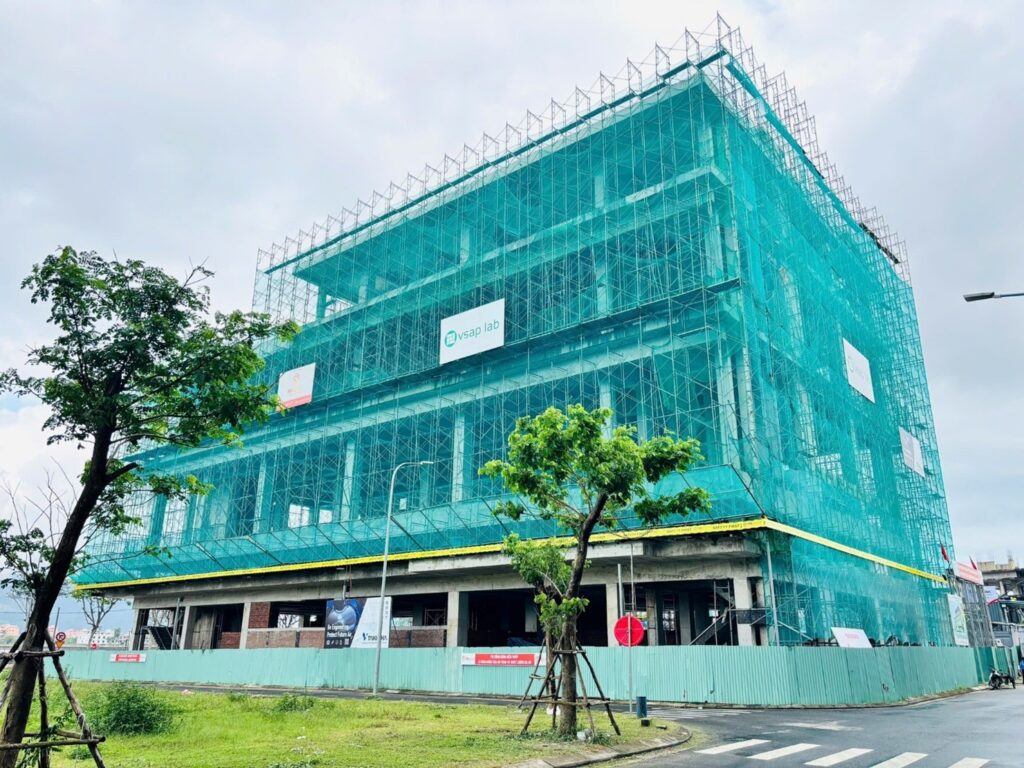
Currently under development in Da Nang, VSAP Lab is designed as Vietnam’s first advanced packaging Lab-Fab, focusing on research and development in advanced packaging technologies, heterogeneous integration, and chiplet-based architectures—areas that are increasingly central to the future of semiconductor innovation.
Unlike large-scale manufacturing fabs designed for mass production, the Lab-Fab model functions as an R&D and prototyping platform, enabling the development and validation of advanced packaging processes, as well as the rapid prototyping of semiconductor products.
This approach reflects a broader industry trend: as Moore’s Law slows, innovation is shifting toward advanced packaging and chiplet integration, which allow multiple chips to be combined into high-performance systems.
By establishing a dedicated Lab-Fab infrastructure, VSAP Lab aims to position Vietnam within this emerging technological frontier.
Supporting the next generation of semiconductor talent
Beyond technology development, VSAP Lab is also expected to play an important role in addressing one of Vietnam’s most pressing challenges: the shortage of high-level semiconductor talent.
Advanced packaging laboratories and pilot production lines can provide a bridge between academic research and industrial practice, enabling engineers and researchers to gain hands-on experience with real semiconductor processes.
VSAP Lab plans to collaborate with universities and research institutes to support training programs for engineers and graduate students. In particular, the facility could help enable doctoral-level research programs in semiconductor design and advanced packaging technologies starting around 2027.
Such initiatives are seen as essential for developing a new generation of semiconductor experts capable of supporting Vietnam’s long-term industry ambitions.
Toward a resilient semiconductor ecosystem
The discussions at the national steering committee meeting underscore Vietnam’s determination to develop a comprehensive semiconductor ecosystem that integrates policy support, industrial capability, and advanced education.
As global semiconductor supply chains continue to diversify, the emergence of R&D-focused Lab-Fab platforms, chip design centers, manufacturing projects, and specialized training programs is expected to strengthen Vietnam’s position in the global technology landscape.
In this evolving ecosystem, initiatives such as VSAP Lab’s advanced packaging Lab-Fab in Da Nang represent a new model for innovation infrastructure—one that connects research, education, and industry to accelerate the development of domestic semiconductor capabilities.
As Vietnam continues its semiconductor journey, such platforms could play a crucial role in helping the country move beyond assembly and testing toward higher-value segments of the global semiconductor value chain.
(Phuc Le)

 Tiếng Việt